12497 South Tamiami Trail, Unit 2, North Port, FL
A Fixed Solution for a Missing Tooth
A gap left by a missing tooth does more damage than most people realize. The bone underneath begins shrinking within months, neighboring teeth drift toward the space and the tooth above or below starts moving down to meet it. Over time, that changes your bite, creates food traps and puts stress on the surrounding teeth. A dental bridge stops that process by filling the space with a fixed restoration anchored to the teeth on either side, so there is nothing to remove and nothing to take in and out.
Dr. Annie Smith plans and places every bridge at our North Port office, from the initial examination through to the final fit. Because she is the sole provider here, the same dentist who assessed the problem designs the solution and places it, and she checks the fit and your bite personally before anything is permanently cemented. Every bridge she places is backed by our one-year warranty.
Schedule a Bridge Consultation
What Is a Dental Bridge?
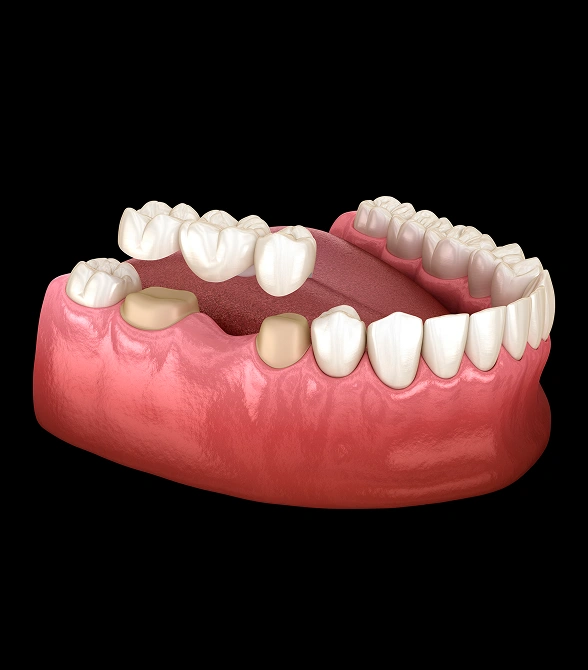
A dental bridge is a fixed restoration that spans a gap left by one or more missing teeth. It consists of one or more artificial teeth, called pontics, held in place by crowns on the natural teeth or implants on either side of the space. Those supporting teeth are called abutments, and once the bridge is cemented, the whole structure functions as a single connected unit.
Unlike a denture or partial, a bridge is not removable. It is permanently attached and cleaned like natural teeth, with floss threaded underneath using a floss threader or interdental brush. Because it is fixed in place, it feels and functions much more like a natural tooth than a removable appliance does, and most patients adjust to it within a few days.
A bridge does not replace the root of the missing tooth, which means the bone underneath the pontic will continue to resorb slowly over time. For patients where long-term bone preservation matters most, Dr. Smith will explain the difference and let you weigh both options.
Types of Bridges and Which One Fits Your Situation
Not every gap calls for the same design. Dr. Smith recommends a bridge type based on the number of missing teeth, the health of the surrounding teeth and where the gap sits in the mouth.
- Traditional bridge - The most common type. Crowns are placed on the teeth on both sides of the gap, with an artificial tooth suspended between them. Reliable and time-tested, suited to most single tooth gaps with healthy abutment teeth on each side.
- Cantilever bridge - Used when there is only one natural tooth available as an anchor, rather than one on each side. Less common and reserved for specific situations, since the single anchor carries more load. Dr. Smith will tell you honestly if this is not the right design for your gap.
- Implant-supported bridge - Instead of relying on neighboring teeth, the bridge anchors to dental implants placed in the jaw. This preserves the neighboring teeth entirely and maintains bone in the gap area. A strong option when the adjacent teeth are healthy and worth protecting, or when multiple consecutive teeth are missing.
- Maryland bridge - A more conservative option where the artificial tooth is held by thin wings bonded to the back of the adjacent teeth rather than crowns. Suited to front teeth in patients who want to avoid preparing healthy neighboring teeth.
How a Dental Bridge Is Placed at Wellen Family Dental
Getting a bridge takes two appointments, typically one to two weeks apart, while the permanent restoration is made at the dental laboratory.
Examination and treatment planning
Dr. Smith examines the gap, the abutment teeth and the surrounding bone on X-ray, and confirms a bridge is the right option for your situation. She discusses materials and explains what the neighboring teeth will need.
Preparing the abutment teeth
The teeth on either side of the gap are numbed and reshaped to accept crowns. This step removes a small amount of enamel and is permanent, which is one of the reasons an implant-supported option is worth discussing when those teeth are otherwise healthy.
Impressions and shade matching
A mold or scan captures the prepared teeth, the gap and your bite. The shade is matched to your surrounding teeth so the finished bridge blends in naturally.
Fitting a temporary bridge
A temporary restoration protects the prepared teeth and fills the gap while the permanent bridge is being made, so you can eat and speak normally in between visits.
Lab fabrication
Your permanent bridge is custom-made over one to two weeks, built to fit the precise dimensions of the prepared teeth and the gap.
Fitting and adjusting the permanent bridge
At the second visit, the temporary is removed and the permanent bridge is seated, checked for fit and adjusted until the bite feels right. Dr. Smith checks every contact point before cementing.
Permanent cementation
Once fit and bite are confirmed, the bridge is permanently cemented. Most patients adapt within a few days.
Caring for a Dental Bridge Long Term
A bridge can last ten to fifteen years or considerably longer with the right care. The most important thing to understand is that the teeth underneath the crowns and the gum around the pontic still need cleaning, because decay at the edge of a crown or gum disease around an abutment tooth is the most common reason a bridge fails prematurely.
Flossing a bridge requires threading under the pontic, which a floss threader or water flosser makes straightforward once it becomes routine. Brushing technique around the gumline of each crown matters too. Beyond that, the habits that protect a bridge are the same ones that protect natural teeth.
If anything feels loose, your bite changes or you notice sensitivity around a crowned tooth, call us rather than waiting. Early attention to a bridge issue is always simpler than a late one.
Fill the Gap Before It Causes More Problems
The longer a gap is left, the more the surrounding teeth and bone change around it. Dr. Smith will examine the space, explain your options clearly and give you a written estimate before you decide anything. Most insurance accepted, membership plan takes 20% off from $33 a month, and every bridge we place is guaranteed for a full year.
Request Appointment